Elliptic Curves
ECC is a set of public-key cryptographic algorithms based on elliptic curves over finite fields. It is used to create digital signatures and key exchanges.
General definition
As ECC relies on unusual mathematical problems and some concepts are very specific to this, the definition part is more detailed than orther sections.
Note: This section was made using the following resources:
| Name | Author |
|---|---|
| Elliptic Curves Challenges | CryptoHack |
| Elliptic Curve notes | Ben Lynn |
| An Introduction to Mathematical Cryptography | Jeffrey Hoffstein, Jill Pipher, Joseph H. Silverman |
Elliptic curve
Given a field and two constants , an elliptic curve over is the set of points that satisfy the equation :
To be a valid elliptic curve, the discriminant must be non-zero, i.e . Otherwise, the curve is called a singular curve.
We can already notice:
- The curve is symmetric about the -axis, because
- The curve contains a point at infinity .
Point adition
We can now define the addition of two points on an elliptic curve.
- If , then the line is the tangent to the curve at .
- If there is no third point of intersection, then the result is which can be seen as the point at infinity.
This figure represents :
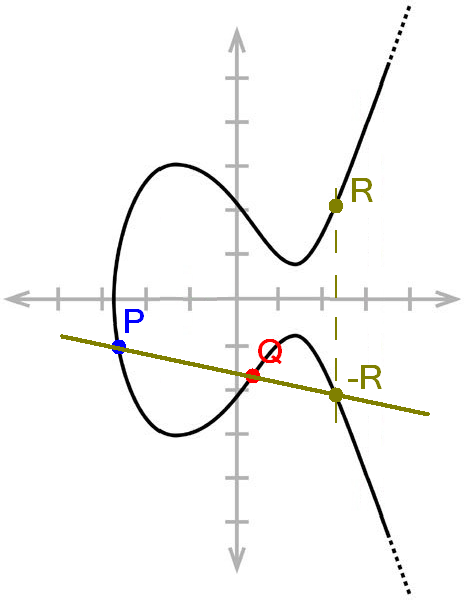
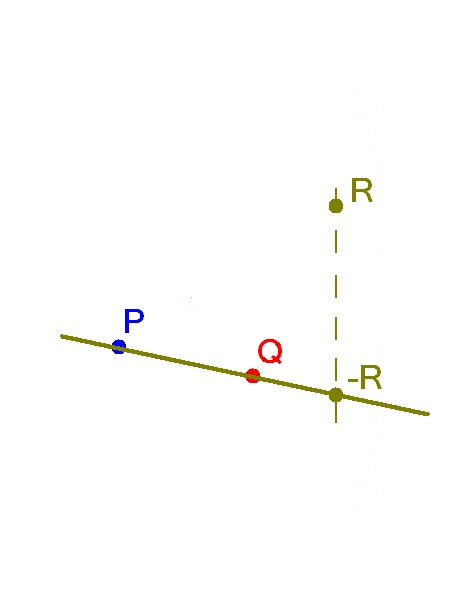
The following properties can be observed:
- If and have rational coordinates, then so does .
- (The point at infinity is the identity element.)
- (The inverse of a point is its reflection about the -axis.)
- (Addition is commutative.)
- (Addition is associative.)
These properties makes the set of points on an elliptic curve coupled with the point addition operation an abelian group.
Point addition can be computed using the following formulas:
If :
If :
EC Cryptography
In ellyptic curve cryptography, the coordinates of points are usually in a prime finite field where is a prime number. However, it is also possible to use a binary fields .
Because of this, the set of points that verifies the equation of an elliptic curve can no longer be seen as a simple geometric curve. Now, the space can be seen as a rectangular grid of points. The left and right edges of the grid are connected, as well as the top and bottom edges. This is called a torus.
For exemple, here is the set of points of the elliptic curve over :
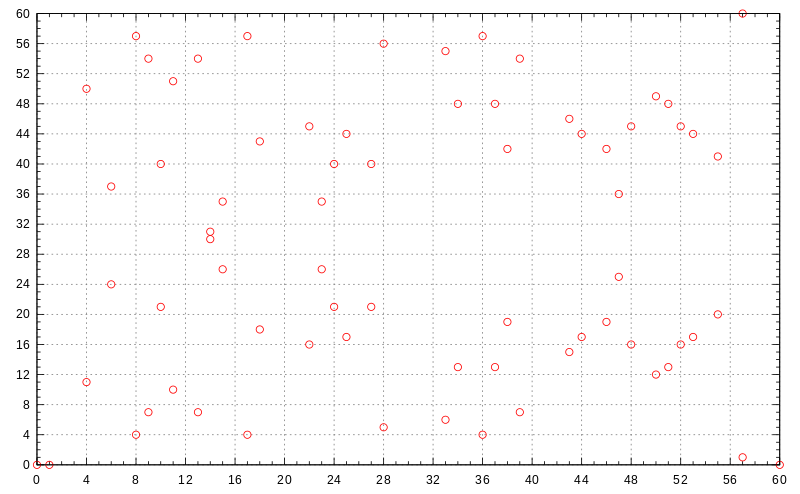
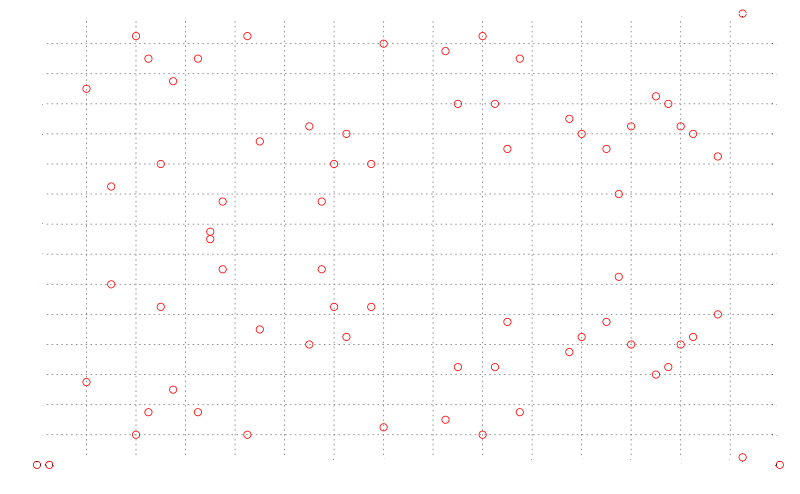
We notice that:
- Point addition as we defined it before still works on this grid. See this website for visual examples.
- is now (0, 0)
- Because the curve is symmetric about the -axis and the space is finite, there is a new symmetry axis at the center of the grid.
Here is python sagemath code that defines the elliptic curve over and computes :
p = 61
F = GF(p)
E = EllipticCurve(F, [-1, 0])
P = E(8, 4)
Q = E(17, 4)
R = P + Q # = R(36, 57)
Scalar multiplication
We can now define the scalar multiplication of a point by an integer .
This operation is the trapdoor function of ECC, as inversing it is considered to be very hard. This problem is called the elliptic curve discrete logarithm problem (ECDLP): given and , find such that .
Tricks
Point from x
Usually, public and private keys are not given as a point on the curve but as an integer. It is sometimes easier to work with the coordinate of the point, as there are only two possible values for for a given . If is a solution, is the other one. In addition, using either or does not change the result of computations.
Here is a python sagemath function that returns the point from its coordinate:
P = E.lift_x(x, all=True)[0]
Attacks
Bad parameters
Smooth order using Pohlig–Hellman - Wikipedia
If the order of the curve is smooth (i.e have a lot of small - under 10**12 - factors), the Pohlig–Hellman algorithm can be used to compute the discrete logarithm very quickly. Consequently, if he order is not prime itself, it must al least contain a large prime factor to prevent this.
Sagemath’s discrete_log function can be used to compute the discrete logarithm for such primes. This script can be used to generate smooth numbers of selected size while this script can be used to compute the discrete logarithm on EC points.
MOV attack - StackExchange
Some curves are vulnerable if they have a small embedding degree, such as supersingular curves.
Embedding degreeThe embedding degree is the smallest integer such that the curve can be embedded in a field :
If is small, the discrete logarithm can be computed in .
This script can be used to compute the discrete logarithm on EC points using the MOV attack.
Smart’s attack on an anomalous curve
When the order of the curve is the same as the prime of the field, the curve is called an anomalous curve. In this case, the discrete logarithm can be computed using smart’s attack from Lifts and Hensel’s Lemma. A description of the attack can be found here.
This github repository contains an implementation of smart’s attack.
Singular curve - StackExchange
If the discriminant of the curve is zero, the curve is called a singular curve. In this case, there is a bijection between the points of the curve and groups where the discrete logarithm is easy to compute.
This repository contains an implementation of the attack.
Bad implementations
CurveBall (CVE-2020-0601) - GitHub
This attack exploits a vulnerability in the implementation of the Curve25519 curve in Windows crypto API. The implementation does not check the provided generator and uses it for computations, making it possible to forge certificates for any domain.
Elliptic Curves on Real numbers - Cryptohack
Discrete logarithm on elliptic curves over real numbers can be reduced to SVP using many methods.